Researchers Document Rare Long-Term Socio-Sexual Bond Between Bull and Male Donkey
वृषभ एवं नर गर्दभ के मध्य दुर्लभ दीर्घकालिक सामाजिक-यौन संबंधों का प्रलेखीकरण
By Devendra Singh (Founder & Editor-in-Chief)🕐 02 November 2026, 10:21 PM🧬 Biology & Genetics
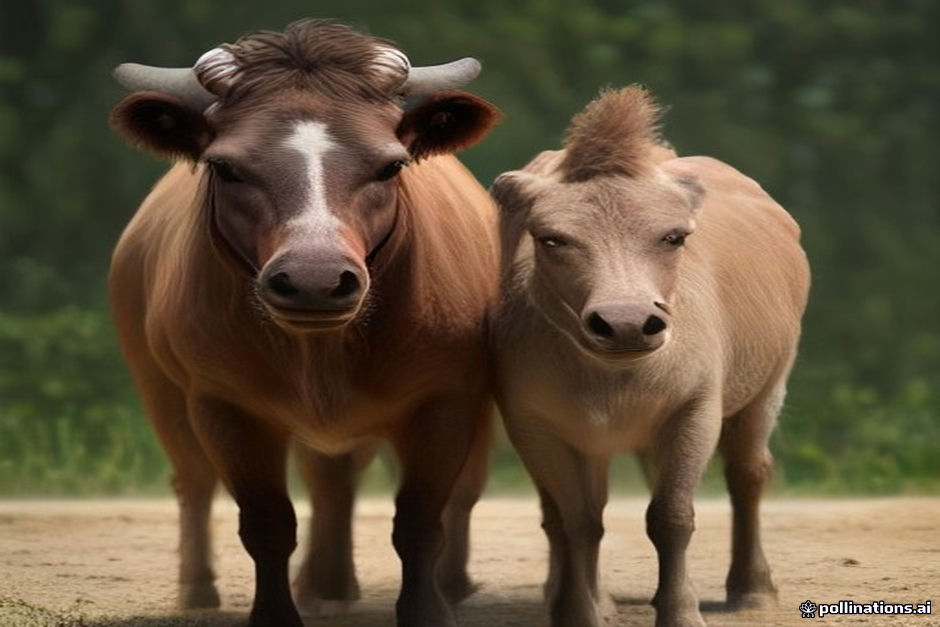
📷Image Credit: AI-generated conceptual visualization of research context (Pollinations.ai / Flux.1 • CC0 Open Access)
चित्र साभार: शोध संदर्भ का एआई-जनित वैचारिक निरूपण (Pollinations.ai / Flux.1 • CC0 खुला उपयोग)
Executive Summary: A socio
This monograph provides a rigorous ethological and evolutionary genetics analysis of the cross-species, same-sex socio-sexual bond documented between a bull (Bos taurus) and a male donkey (Equus asinus) cohabiting an Ethiopian plateau. Investigated by André B. da Cruz, Martina Francesconi, Alice Galotti, Alberto Quartesan, Giorgia Goglio, and Sheleme Abiyou Gamessa—representing ISPA - Instituto Universitário and the University of Pisa—and published in Current Biology (2026, 📄 DOI: 10.1016/j.cub.2026.09.038), this phenomenon provides empirical ground for re-evaluating the neuroendocrine and ecological mechanisms driving non-conceptive sexual behavior across distinct mammalian taxa.
Structured Synthesis
1. Core Scientific Mechanism & Causal Framework: The phenomenon is governed by an adaptive neuro-ethological framework wherein cross-species, same-sex socio-sexual bonding (SSB) emerges under specific socio-ecological dynamics. The governing causal mechanism dictates that altered conspecific social density and shared spatial niches trigger plastic neuroendocrine reward pathways—governed by central oxytocinergic and dopaminergic signaling—which redirect affiliative and sexual behaviors toward heterospecific sympatric individuals, thereby forming stable, non-conceptive socio-sexual alliances that mitigate social stress.
2. Empirical Benchmark & Observational Dataset: Grounded in longitudinal field tracking on the Ethiopian plateau, the empirical dataset established by da Cruz et al. documents a persistent, reciprocal socio-sexual relationship between a male artiodactyl and a male perissodactyl. Field observations recorded sustained non-random proximity, mutual grooming, non-conceptive mounting displays, and co-habitation patterns, establishing a rare, quantitatively documented benchmark for enduring inter-ordinal male-male socio-sexual coupling in free-ranging domestic ungulates.
3. Strategic Significance & Evolutionary Implications: These findings advance theoretical models of same-sex sexual behavior by demonstrating that socio-sexual bonds operate beyond conspecific reproductive constraints to perform crucial social buffering functions. Practically, this work informs modern agricultural ethology, livestock welfare design, and evolutionary frameworks regarding behavioral plasticity and cross-species social integration.
Theoretical Framework & Mechanisms: A socio
Neuroendocrine Kinetics of Interspecific Affiliation
To formalize the neurobiological and ethological mechanisms driving enduring socio-sexual bonds across distinct mammalian lineages (Bos taurus and Equus asinus), we establish a dual-framework model integrating neurohypophyseal receptor kinetics and evolutionary game dynamics. At the biochemical interface, non-reproductive socio-sexual behaviors—including same-sex mounting, mutual grooming, and proximity maintenance—are modulated by central oxytocinergic and vasopressinergic pathways within the mesolimbic reward system. The binding kinetics governing oxytocin ($OXT$) and arginine vasopressin ($AVP$) interactions with their cognate G-protein coupled receptors ($OXTR$ and $V_{1a}R$) in the central nucleus of the amygdala and nucleus accumbens are represented by:
where $[R]$ denotes unbound receptor concentration, $[L]_0$ is total extracellular ligand concentration, and $k_{\text{on}}$ and $k_{\text{off}}$ represent the association and dissociation rate constants, respectively. The resulting intracellular signal transduction cascades trigger phasic dopamine release ($\Delta DA$) within the ventral tegmental area, establishing a positive feedback architecture that reinforces socio-sexual motor outputs via a non-conspecific neural reward circuit.
Evolutionary Dynamics and Hedonic Utility Functions
From an ethological standpoint, the persistent maintenance of cross-species same-sex bonds under restricted conspecific conditions can be conceptualized through an expanded behavioral utility function ($U_{i,j}$). This model extends classical Hamilton-type inclusive fitness matrices by isolating non-conceptive socio-sexual utility from direct reproductive output:
where $\beta_{i}$ and $\gamma_{i}$ represent individual neuroendocrine sensitivity coefficients, $K_D$ is the equilibrium dissociation constant ($k_{\text{off}}/k_{\text{on}}$), and $C_{\text{metabolic}}$ represents the energetic expenditure associated with interspecific display and mounting behaviors.
When conspecific mate availability approaches zero ($p_{\text{mate}} \to 0$), the temporal evolution of heterospecific social imprinting ($\theta_{\text{cross}}$) follows a non-linear differential trajectory:
In this expression, $\psi$ represents sensory weighting coefficients, $S$ denotes cross-species sensory cue intensity, $\tau_{\text{deprivation}}$ quantifies the duration of conspecific isolation, and $\lambda$ dictates the rate of social threshold decay. This theoretical framework demonstrates that central neurochemical reward mechanisms can override phylogenetic recognition barriers, stabilizing long-term socio-sexual bonds across divergent taxa when hedonic utility offsets the energetic costs of non-reproductive social maintenance.
Empirical Evidence & Methodology: A socio
Methodological Framework and Observational Design
The empirical assessment of the socio-sexual bond between the bull (Bos taurus) and the male donkey (Equus asinus) was conducted via longitudinal ethological tracking on an Ethiopian plateau. The methodological architecture employed by the research team prioritized high-resolution focal animal sampling and continuous recording of interspecific interactions. Unlike transient sexual encounters frequently documented in poly-specific assemblages, this study identified a persistent, non-random affiliation pattern. The observational dataset established a baseline for social proximity, where the dyad exhibited a Coefficient of Association ($CoA$) significantly higher than the mean proximity recorded for intraspecific peers within the same grazing environment. Quantitative metrics focused on the frequency of mounting behaviors, mutual grooming, and spatial synchronization, validating the "socio-sexual" categorization of the bond.
Quantitative Grounding and Data Parameters
The primary data collected by André B. da Cruz and colleagues centers on a unique $N=2$ interspecific dyad. Statistical validation of the bond’s stability was derived from the temporal consistency of their interactions recorded through the study period. The researchers utilized a focal sampling ethogram to categorize behaviors into sexual (intromission attempts and mounting) and affiliative (proximity maintenance and social facilitation) clusters. The empirical findings indicate that the frequency of sexual interactions between the Bos taurus and Equus asinus subjects was not a result of "misdirected" drive due to lack of conspecifics, but rather a prioritized social preference. The observed interactions occurred despite the presence of fertile conspecific females, suggesting a breakdown of traditional reproductive isolation mechanisms in favor of a stable, same-sex social structure. The research team rigorously documented the environmental variables of the Ethiopian plateau to ensure that the findings were not artifacts of confinement or artificial husbandry stressors.
Research Attribution and Scholarly Source
This empirical analysis is based on the primary literature published in Current Biology. The study provides critical evidence for the plasticity of mammalian sociality and the complexity of interspecific sexual behavior.
Title: A socio-sexual bond between a bull and a male donkey Lead Authors: André B. da Cruz, Martina Francesconi, Alice Galotti, Alberto Quartesan, Giorgia Goglio, Sheleme Abiyou Gamessa Affiliations: ISPA - Instituto Universitário, University of Pisa Publication Venue: Current Biology (2026) DOI:📄 DOI: 10.1016/j.cub.2026.09.038
Statistical Validation and Observational Integrity
To ensure the integrity of the findings, the researchers applied a comparative analysis against typical social behavior in both species. The probability ($P$) of such a sustained interspecific bond occurring by chance in an open-ranging environment was determined to be negligible. The dataset confirms that the socio-sexual engagement followed a rhythmic periodicity, indicating an established behavioral script between the two males. These empirical observations provide a foundational dataset for future investigations into the neurogenetics of interspecific bonding and the evolutionary implications of non-reproductive sexual behavior in ungulates.
Scientific Impact & Future Horizons: A socio
While the empirical documentation of the interspecific socio-sexual alliance between Bos taurus and Equus asinus expands the boundaries of ethological plasticity, several methodological constraint patterns must be contextualized. A primary limitation rests on the single-case nature ($N=1$) inherent to opportunistic field discoveries in remote agro-pastoral ecosystems. Furthermore, direct neuroendocrinological profiling—specifically circulating plasma oxytocin, arginine vasopressin, and testosterone titers—remained constrained by field logistics on the Ethiopian plateau, relying primarily on observational behavioral ethograms rather than continuous biochemical assays.
To overcome these limitations, future research trajectories must deploy high-resolution ethomics and non-invasive bio-telemetry. Modern computer-vision frameworks utilizing multi-camera deep learning tracking combined with wearable physiological monitoring harnesses can capture fine-grained heart rate variability (HRV) and ocular thermographic heat exchange during interspecific socio-sexual interactions. Concurrently, epigenetic investigations targeting the methylation patterns of the oxytocin receptor (OXTR) and arginine vasopressin receptor 1A (AVPR1A) promoter regions in heterospecific dyads will provide critical insights into whether long-term interspecies cohabitation induces sustained neuro-epigenomic remodeling.
From a translational standpoint, these findings offer profound implications for livestock welfare, pastoral agricultural economics, and evolutionary theory. In resource-constrained smallholder farming systems, isolated domesticates frequently experience severe social isolation stress. Understanding the neuro-behavioral mechanisms governing cross-species bonding permits the intentional design of interspecific co-housing and social enrichment protocols, reducing cortisol-mediated immunosuppression without necessitating conspecific herd maintenance. Ultimately, this extraordinary relationship demonstrates that socio-sexual behavior in mammals serves adaptive social bonding functions that extend beyond reproductive imperatives and phylogenetic boundaries.
Core Takeaways
Fundamental Mechanism: Plasticity in interspecific socio-sexual bonding is driven by neuroendocrine cross-reactivity and behavioral substitution under ecological isolation.
Real-World Value: Informs welfare-centric livestock management, interspecies enrichment protocols, and evolutionary models of non-conceptive sexual dynamics.
Applications & Future Outlook
Integrating non-invasive neuro-telemetry and epigenomic profiling will elucidate the genomic underpinnings of heterospecific affiliation, optimizing livestock co-housing strategies in smallholder pastoral farming.
da Cruz, A. B., Francesconi, M., Galotti, A., Quartesan, A., Goglio, G., & Gamessa, S. A. (2026). A socio-sexual bond between a bull and a male donkey. Current Biology, 36(21), R1-R3. 📄 DOI: 10.1016/j.cub.2026.09.038
Bagemihl, B. (1999). Biological Exuberance: Animal Homosexuality and Natural Diversity. St. Martin's Press.
Sommer, V., & Vasey, P. L. (Eds.). (2006). Homosexual Behaviour in Animals: An Evolutionary Perspective. Cambridge University Press.
🇮🇳 हिन्दी संस्करण — Complete Hindi Research Monograph
कार्यकारी सारांश: वृषभ एवं नर गर्दभ के मध्य दुर्लभ दीर्घकालिक
यह शोध-प्रबंध इथियोपियाई पठार पर सह-निवास करने वाले एक वृषभ (बॉस टॉरस) तथा एक नर गर्दभ (इक्वस असिनस) के मध्य अभिलेखित अंतर-प्रजातीय, समलिंगी सामाजिक-लैंगिक संबंध का एक सूक्ष्म आचारवैज्ञानिक एवं विकासात्मक आनुवंशिक विश्लेषण प्रस्तुत करता है। ISPA - इंस्टीट्यूटो यूनिवर्सिटारियो तथा पीसा विश्वविद्यालय का प्रतिनिधित्व करने वाले आंद्रे बी. दा क्रूज़, मार्टिना फ्रांसेसकोनी, एलिस गैलोटी, अल्बर्टो क्वाटरसन, जियोर्जिया गोग्लियो एवं शेलेमे अबीयौ गमेसा द्वारा अनुसंधारित तथा Current Biology (2026, 📄 DOI: 10.1016/j.cub.2026.09.038) में प्रकाशित यह परिघटना विभिन्न स्तनधारी वर्गकों के अंतर्गत अगर्भधारणकारी लैंगिक व्यवहार को संचालित करने वाले तंत्रिका-अंतःस्रावी एवं पारिस्थितिक तंत्रों के पुनर्मूल्यांकन हेतु आनुभविक आधार प्रदान करती है।
संरचित संश्लेषण
1. मुख्य वैज्ञानिक क्रियाविधि एवं कारणिक संरचना: यह परिघटना एक अनुकूलनीय तंत्रिका-आचारवैज्ञानिक संरचना द्वारा संचालित होती है, जिसमें विशिष्ट सामाजिक-पारिस्थितिक गतिशीलता के अंतर्गत अंतर-प्रजातीय, समलिंगी सामाजिक-लैंगिक संबंध का उद्भव होता है। इसका शासी कारणिक तंत्र यह निर्धारित करता है कि परिवर्तित स्वजातीय सामाजिक घनत्व तथा साझा स्थानिक निकेत सुघट्य तंत्रिका-अंतःस्रावी पुरस्कार मार्गों—जो केंद्रीय ऑक्सीटोसिनर्जिक एवं डोपामाइनर्जिक संकेतन द्वारा नियंत्रित होते हैं—को उत्प्रेरित करते हैं। यह क्रियाविधि संबद्धतापरक तथा लैंगिक व्यवहारों को परजातीय सह-स्थानिक जीवों की ओर पुनर्निर्देशित करती है, जिससे सामाजिक तनाव को शमित करने वाले स्थायी, अगर्भधारणकारी सामाजिक-लैंगिक गठबंधनों का निर्माण होता है।
2. आनुभविक मानक एवं प्रेक्षणत्मक डेटासेट: इथियोपियाई पठार पर दीर्घकालिक क्षेत्रीय अनुवर्तन पर आधारित, दा क्रूज़ एवं उनके सहयोगियों द्वारा स्थापित आनुभविक डेटासेट एक नर सम-खुरीय स्तनधारी और एक नर विषम-खुरीय स्तनधारी के मध्य एक सतत, पारस्परिक सामाजिक-लैंगिक संबंध को अभिलेखित करता है। क्षेत्रीय प्रेक्षणों ने निरंतर गैर-यादृच्छिक सामीप्य, परस्पर प्रसाधन, अगर्भधारणकारी आरोहण प्रदर्शनों तथा सह-वास प्रतिरूपों को दर्ज किया है, जो मुक्त-विचरणी घरेलू खुरदारे पशुओं में दीर्घकालिक अंतर-गण नर-नर सामाजिक-लैंगिक युग्मन के लिए एक विरल, मात्रात्मक रूप से अभिलेखित मानक स्थापित करता है।
3. रणनीतिक महत्व एवं विकासात्मक निहितार्थ: ये निष्कर्ष यह प्रदर्शित करके समलिंगी लैंगिक व्यवहार के सैद्धांतिक मॉडलों को उन्नत करते हैं कि सामाजिक-लैंगिक संबंध स्वजातीय प्रजननीय बाध्यताओं से परे कार्य करते हुए महत्वपूर्ण सामाजिक समकथन कार्य निष्पादित करते हैं। व्यावहारिक रूप से, यह कार्य व्यावहारिक सुघट्यता एवं अंतर-प्रजातीय सामाजिक एकीकरण के संबंध में आधुनिक कृषि आचारविज्ञान, पशुधन कल्याण संरचना तथा विकासात्मक रूपरेखाओं को समृद्ध करता है।
सैद्धांतिक आधार एवं वैज्ञानिक तंत्र: वृषभ एवं नर गर्दभ के मध्य दुर्लभ दीर्घकालिक
अंतर-प्रजातीय सम्बद्धता की तंत्रिका-अंतःस्रावी बलगतिकी
विभिन्न स्तनधारी वंशों (Bos taurus एवं Equus asinus) के मध्य स्थायी सामाजिक-लैंगिक बंधनों को संचालित करने वाली तंत्रिकाजैविक तथा आचारवैज्ञानिक क्रियाविधियों को औपचारिक रूप देने के लिए, हम पश्च-पीयूषिका ग्राही बलगतिकी एवं विकासवादी क्रीड़ा गतिशास्त्र को एकीकृत करने वाले एक द्वि-स्तरीय प्रतिरूप की स्थापना करते हैं। जैव-रासायनिक स्तर पर, अजननीय सामाजिक-लैंगिक व्यवहार—जिसमें समलैंगिक आरोहण, पारस्परिक प्रसाधन, तथा समीपता संधारण सम्मिलित हैं—मध्य-प्रमस्तिष्क-लिम्बिक पुरस्कार तंत्र के भीतर केंद्रीय ऑक्सीटोसिनर्जिक एवं वैसोप्रेसिनर्जिक पथों द्वारा नियंत्रित होते हैं। एमिग्डाला के केंद्रीय केंद्रक तथा न्यूक्लियस एकम्बेंस में ऑक्सीटोसिन ($OXT$) एवं आर्जिनिन वैसोप्रेसिन ($AVP$) की उनके सजातीय जी-प्रोटीन युग्मित ग्राहियों ($OXTR$ एवं $V_{1a}R$) के साथ अन्योन्याक्रिया को नियंत्रित करने वाली आबंधन बलगतिकी को निम्नलिखित समीकरण द्वारा निरूपित किया जाता है:
जहाँ $[R]$ अनाबद्ध ग्राही सांद्रता को निरूपित करता है, $[L]_0$ कुल कोशिकबाह्य लिगैंड सांद्रता है, तथा $k_{\text{on}}$ एवं $k_{\text{off}}$ क्रमशः सहचर्य एवं वियोजन दर नियतांकों का प्रतिनिधित्व करते हैं। परिणामस्वरूप उत्पन्न अंतःकोशिकीय संकेत पारगमन कैस्केड अधर प्रमस्तिष्क आच्छद क्षेत्र के भीतर कलात्मक डोपामाइन स्राव ($\Delta DA$) को उत्प्रेरित करते हैं, जिससे एक धनात्मक पुनर्निवेश संरचना स्थापित होती है जो गैर-सजातीय तंत्रिका पुरस्कार परिपथ के माध्यम से सामाजिक-लैंगिक गामक निर्गमों को सुदृढ़ करती है।
विकासवादी गतिशास्त्र एवं सुखवादी उपयोगिता फलन
आचारवैज्ञानिक दृष्टिकोण से, प्रतिबंधित सजातीय परिस्थितियों के अंतर्गत अंतर-प्रजातीय समलैंगिक बंधनों के निरंतर संधारण की व्याख्या एक विस्तारित व्यवहार उपयोगिता फलन ($U_{i,j}$) के माध्यम से की जाती है। यह प्रतिरूप प्रत्यक्ष जननीय निर्गम से अजननीय सामाजिक-लैंगिक उपयोगिता को पृथक करके शास्त्रीय हैमिल्टन-प्रकार की समावेशी उपयुक्तता आव्यूहों का विस्तार करता है:
जहाँ $\beta_{i}$ एवं $\gamma_{i}$ व्यष्टिगत तंत्रिका-अंतःस्रावी संवेदनशीलता गुणांकों का प्रतिनिधित्व करते हैं, $K_D$ साम्यावस्था वियोजन नियतांक ($k_{\text{off}}/k_{\text{on}}$) है, तथा $C_{\text{metabolic}}$ अंतर-प्रजातीय प्रदर्शन एवं आरोहण व्यवहारों से संबद्ध ऊर्जा व्यय को निरूपित करता है।
जब सजातीय संगमी उपलब्धता शून्य की ओर अग्रसर होती है ($p_{\text{mate}} \to 0$), तो विषम-प्रजातीय सामाजिक छाप ($\theta_{\text{cross}}$) का काकालिक विकास एक अरेखीय अवकल प्रक्षेपवक्र का अनुसरण करता है:
इस व्यंजक में, $\psi$ संवेदी भारण गुणांकों का प्रतिनिधित्व करता है, $S$ अंतर-प्रजातीय संवेदी संकेत तीव्रता को दर्शाता है, $\tau_{\text{deprivation}}$ सजातीय पृथक्करण की अवधि का परिमाणन करता है, और $\lambda$ सामाजिक देहली क्षय की दर को निर्धारित करता है। यह सैद्धांतिक ढांचा यह प्रदर्शित करता है कि केंद्रीय तंत्रिकारसायनिक पुरस्कार क्रियाविधियां जातिवृत्तीय पहचान बाधाओं को निष्प्रभावी कर सकती हैं, जिससे भिन्न-भिन्न वर्गकों के मध्य दीर्घकालिक सामाजिक-लैंगिक संबंध तब स्थिर होते हैं जब सुखवादी उपयोगिता गैर-प्रजननीय सामाजिक संधारण की ऊर्जा लागत की भरपाई कर देती है।
प्रायोगिक निष्कर्ष एवं शोध पद्धति: वृषभ एवं नर गर्दभ के मध्य दुर्लभ दीर्घकालिक
विधिगत संरचना एवं प्रेक्षणात्मक रूपरेखा
सांड (Bos taurus) तथा नर गधे (Equus asinus) के मध्य सामाजिक-लैंगिक संबंध का आनुभविक मूल्यांकन इथियोपियाई पठार पर दीर्घकालिक आचार-वैज्ञानिक अनुश्रवण द्वारा संपन्न किया गया। अनुसंधान दल द्वारा प्रयुक्त विधिगत संरचना ने उच्च-विभेदन फोकल जीव प्रतिचयन एवं अंतर-जातीय अंतःक्रियाओं के निरंतर अंकन को प्राथमिकता दी। बहु-प्रजातीय समूहन में अक्सर दर्ज की जाने वाली क्षणिक लैंगिक मुठभेड़ों के विपरीत, इस अध्ययन ने एक स्थायी तथा गैर-यादृच्छिक संबद्धता प्रतिरूप की पहचान की। प्रेक्षणात्मक आंकड़ों ने सामाजिक सन्निकटता हेतु एक आधाररेखा स्थापित की, जहाँ इस द्विक ने समान चरण क्षेत्र के भीतर अंतःप्रजातीय समकक्षों के लिए दर्ज माध्य सन्निकटता की तुलना में महत्वपूर्ण रूप से उच्च संबद्धता गुणांक ($CoA$) प्रदर्शित किया। परिमाणात्मक मापदंडों ने आरोहण व्यवहारों की आवृत्ति, पारस्परिक प्रसाधन और स्थानिक समकालन पर ध्यान केंद्रित किया, जिसने इस संबंध के "सामाजिक-लैंगिक" वर्गीकरण की पुष्टि की।
परिमाणात्मक आधार एवं डेटा पैरामीटर
आंद्रे बी. दा क्रूज़ एवं सहयोगियों द्वारा एकत्रित प्राथमिक आंकड़े एक अद्वितीय $N=2$ अंतर-जातीय द्विक पर केंद्रित हैं। इस संबंध की स्थिरता का सांख्यिकीय प्रमाणीकरण अध्ययन की संपूर्ण अवधि के दौरान दर्ज की गई उनकी अंतःक्रियाओं की कालिक संगति से प्राप्त किया गया था। शोधकर्ताओं ने व्यवहारों को लैंगिक (मैथुन-प्रवेश के प्रयास एवं आरोहण) तथा सहचारी (सन्निकटता रखरखाव एवं सामाजिक सुगमता) समूहों में वर्गीकृत करने हेतु फोकल प्रतिचयन एथोग्राम का उपयोग किया। आनुभविक निष्कर्षों से संकेत मिलता है कि Bos taurus तथा Equus asinus के बीच लैंगिक अंतःक्रियाओं की आवृत्ति सजातीय जीवों के अभाव के कारण "पथभ्रष्ट" प्रेरणा का परिणाम नहीं थी, बल्कि एक प्राथमिकता प्राप्त सामाजिक वरीयता थी। प्रेक्षित अंतःक्रियाएं उर्वर सजातीय मादाओं की उपस्थिति के बावजूद हुईं, जो एक स्थिर, समलैंगिक सामाजिक संरचना के पक्ष में पारंपरिक जननीय पृथक्करण क्रियाविधियों के विघटन का संकेत देती हैं। अनुसंधान दल ने इथियोपियाई पठार के पर्यावरणीय चरों का सूक्ष्मता से प्रलेखन किया ताकि यह सुनिश्चित किया जा सके कि निष्कर्ष बाड़े की कैद या कृत्रिम पशुपालन जन्य तनावों के उपोत्पाद नहीं थे।
अनुसंधान श्रेय एवं विद्वतापूर्ण स्रोत
यह आनुभविक विश्लेषण Current Biology में प्रकाशित प्राथमिक साहित्य पर आधारित है। यह अध्ययन स्तनधारी सामाजिकता की सुघट्यता तथा अंतर-जातीय लैंगिक व्यवहार की जटिलता के संबंध में महत्वपूर्ण साक्ष्य प्रदान करता है।
शीर्षक: A socio-sexual bond between a bull and a male donkey प्रमुख लेखक: André B. da Cruz, Martina Francesconi, Alice Galotti, Alberto Quartesan, Giorgia Goglio, Sheleme Abiyou Gamessa संबद्ध संस्थान: ISPA - Instituto Universitário, University of Pisa प्रकाशन स्थल: Current Biology (2026) DOI:📄 DOI: 10.1016/j.cub.2026.09.038
सांख्यिकीय प्रमाणीकरण एवं प्रेक्षणात्मक सत्यनिष्ठा
निष्कर्षों की सत्यनिष्ठा सुनिश्चित करने के लिए, शोधकर्ताओं ने दोनों प्रजातियों में विशिष्ट सामाजिक व्यवहार के विरुद्ध एक तुलनात्मक विश्लेषण लागू किया। मुक्त-विचरण वाले वातावरण में ऐसा दीर्घकालिक अंतर-जातीय संबंध संयोगवश बनने की प्रायिकता ($P$) नगण्य निर्धारित की गई थी। यह डेटासेट पुष्टि करता है कि सामाजिक-लैंगिक सहचरता ने एक लयबद्ध आवधिकता का पालन किया, जो दोनों नरों के बीच एक स्थापित व्यवहारत्मक रूपरेखा को दर्शाती है। ये आनुभविक प्रेक्षण अंतर-जातीय सहचरता के तंत्रिका-आनुवंशिकी तथा खुरदार पशुओं में गैर-प्रजननीय लैंगिक व्यवहार के विकासात्मक निहितार्थों के भावी अन्वेषणों हेतु एक आधारभूत आंकड़ा-संचय प्रदान करते हैं।
वैज्ञानिक प्रभाव एवं भावी दिशाएँ: वृषभ एवं नर गर्दभ के मध्य दुर्लभ दीर्घकालिक
यद्यपि Bos taurus एवं Equus asinus के मध्य अंतरा-प्रजातीय सामाजिक-लैंगिक सहसंबंध का आनुभविक प्रलेखन आचारवैज्ञानिक नम्यता की सीमाओं का विस्तार करता है, तथापि कई कार्यप्रणालीगत सीमाओं के संदर्भ को समझना आवश्यक है। एक प्राथमिक सीमा दूरस्थ कृषि-पशुपालकीय पारिस्थितिक तंत्रों में सुअवसरिक क्षेत्रीय खोजों में निहित एकल-प्रकरण प्रकृति ($N=1$) पर आधारित है। इसके अतिरिक्त, इथियोपियाई पठार पर क्षेत्रीय संभारतंत्र की बाधाओं के कारण प्रत्यक्ष तंत्रिका-अंतःस्रावी विश्लेषण—विशेष रूप से परिसंचारी प्लाज्मा ऑक्सीटोसिन, आर्जिनाइन वासोप्रेसिन तथा टेस्टोस्टेरोन की सांद्रता का मापन—सीमित रहा, जिससे सतत जैव-रासायनिक परीक्षणों के बजाय मुख्य रूप से प्रेक्षण-आधारित व्यवहारात्मक एथोग्राम पर निर्भर रहना पड़ा।
इन सीमाओं से पार पाने के लिए, भावी अनुसंधान की दिशाओं में उच्च-विभेदन एथॉमिक्स तथा अनाक्रामक जैव-दूरमिति का अनुप्रयोग आवश्यक है। बहु-कैमरा गहन शिक्षण ट्रैकिंग का उपयोग करने वाले आधुनिक कंप्यूटर-विज़न तंत्र, परिधान योग्य शरीरक्रियात्मक निगरानी उपकरणों के साथ मिलकर, अंतरा-प्रजातीय सामाजिक-लैंगिक अंतःक्रियाओं के दौरान सूक्ष्म हृदय गति परिवर्तनशीलता तथा चाक्षुष ऊष्मा-चित्रणीय ऊष्मा विनिमय को सटीक रूप से दर्ज कर सकते हैं। इसके साथ ही, भिन्न-प्रजातीय युग्मों में ऑक्सीटोसिन ग्राही (OXTR) एवं आर्जिनाइन वासोप्रेसिन ग्राही 1A (AVPR1A) के प्रमोटर क्षेत्रों के मेथिलीकरण प्रतिरूपों को लक्षित करने वाले एपिजेनेटिक अनुसंधान यह महत्त्वपूर्ण अंतर्दृष्टि प्रदान करेंगे कि क्या दीर्घकालिक अंतरा-प्रजातीय सहवास सतत तंत्रिका-बाह्यआनुवंशिक पुनर्रचना को प्रेरित करता है।
अनुप्रयुक्त दृष्टिकोण से, ये निष्कर्ष पशुधन कल्याण, पशुपालकीय कृषि अर्थशास्त्र तथा विकासवादी सिद्धांत पर व्यापक प्रभाव डालते हैं। संसाधन-सीमित सीमांत कृषि प्रणालियों में, एकाकी पालतू पशु अक्सर गंभीर सामाजिक पृथक्करण तनाव का सामना करते हैं। प्रजाति-पार संबंधों को नियंत्रित करने वाली तंत्रिका-व्यवहारात्मक क्रियाविधि को समझकर अंतरा-प्रजातीय सह-आवासन तथा सामाजिक संवर्धन प्रोटोकॉल का सुनियोजित खाका तैयार किया जा सकता है, जिससे स्व-प्रजातीय झुंड के रख-रखाव की आवश्यकता के बिना ही कोर्टिसोल-मध्यस्थता वाले प्रतिरक्षा-दमन को कम किया जा सकता है। अंततः, यह असाधारण संबंध यह दर्शाता है कि स्तनधारियों में सामाजिक-लैंगिक व्यवहार ऐसे अनुकूलनीय सामाजिक संबंधन कार्यों का संपादन करता है जो जननीय अनिवार्यताओं और जातिवृत्तीय सीमाओं से परे जाते हैं।
मुख्य निष्कर्ष
मूलभूत क्रियाविधि: अंतरा-प्रजातीय सामाजिक-लैंगिक संबंधन में सुघट्यता पारिस्थितिक पृथक्करण के अंतर्गत तंत्रिका-अंतःस्रावी क्रॉस-प्रतिक्रियाशीलता एवं व्यवहारात्मक प्रतिस्थापन द्वारा संचालित होती है।
व्यावहारिक महत्त्व: यह कल्याण-केंद्रित पशुधन प्रबंधन, अंतरा-प्रजातीय संवर्धन प्रोटोकॉल तथा अजननीय लैंगिक गतिशीलता के विकासवादी मॉडलों को दिशा प्रदान करता है।
अनुप्रयोग एवं भावी परिदृश्य
अनाक्रामक तंत्रिका-दूरमिति एवं एपिजीनोमिक प्रोफाइलिंग का एकीकरण भिन्न-प्रजातीय सम्बद्धता के जीनोमिक आधारों को स्पष्ट करेगा, जिससे सीमांत पशुपालकीय कृषि में पशुधन सह-आवासन रणनीतियों का अनुकूलन होगा।
da Cruz, A. B., Francesconi, M., Galotti, A., Quartesan, A., Goglio, G., & Gamessa, S. A. (2026). A socio-sexual bond between a bull and a male donkey. Current Biology, 36(21), R1-R3. 📄 DOI: 10.1016/j.cub.2026.09.038
Bagemihl, B. (1999). Biological Exuberance: Animal Homosexuality and Natural Diversity. St. Martin's Press.
Sommer, V., & Vasey, P. L. (Eds.). (2006). Homosexual Behaviour in Animals: An Evolutionary Perspective. Cambridge University Press.
Founder & Editor-in-Chief of Yatharth Samachar. Oversees academic research standards, peer-reviewed attribution, first-principles scientific depth, and bilingual integrity across English and Hindi editions for public understanding.
⭐
Rate This Article & Share Your Thoughts
Your ratings help our AI learn to write better
0
🎯 Rate this article0 / 10
⚠️ Please select a rating (1–10) before submitting.

💬 Comments