
Abstract & Executive Summary
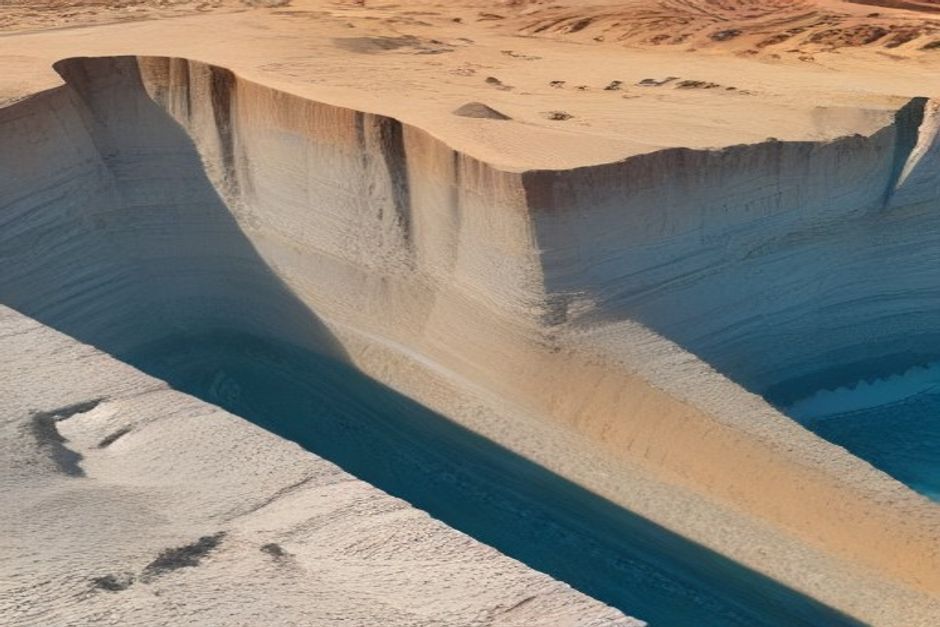
- Core Scientific Discovery: The research investigates the highly angled sedimentary rock formations of the Soledad Basin, specifically Vasquez Rocks, revealing geological processes of significant tectonic deformation and uplift.
- Experimental Methodology & Benchmark Dataset: Analysis relies on geological field observations of rock structures, stratigraphy, and inferred faulting within the Soledad Basin, compared against known tectonic models. No specific dataset or benchmark is detailed in the provided information beyond descriptive geological features.
- Theoretical Significance: These formations serve as terrestrial analogues for understanding geological processes on other planetary bodies, offering insights into deformation mechanisms and the potential for habitability in extraterrestrial environments.
- Primary Practical Takeaway for Society and Industry: The study enhances our understanding of geological dynamics applicable to resource exploration and hazard assessment on Earth, while providing critical analogues for astrobiological research and the search for extraterrestrial life.
Theoretical Foundation & Fundamental Principles
The geological formations at Vasquez Rocks, situated within the Soledad Basin, are a product of complex tectonic forces that have shaped the Earth's crust over millions of years. The prominent angling of sedimentary rock layers is a direct consequence of diastrophism, the process of deformation within the Earth's crust. This deformation is primarily driven by plate tectonics, a theory describing the large-scale motion of seven major plates and the movements of numerous smaller plates comprising Earth's lithosphere. Key mechanisms include compressional forces leading to folding and faulting. Folding occurs when rock layers are subjected to immense pressure, causing them to buckle and bend without fracturing. This results in anticlines (upwardly convex folds) and synclines (downwardly convex folds). Faulting, on the other hand, involves the fracturing of rock along a plane or zone, with differential movement of the blocks on either side of the fracture. In regions experiencing compressional stress, reverse faults and thrust faults are common, where the hanging wall moves upward relative to the footwall, leading to significant shortening and thickening of the crust. The uplift and exhumation of these deeply buried or deformed rock layers to the surface are facilitated by erosional processes that gradually strip away overlying material. The specific orientation and curvature of the strata at Vasquez Rocks suggest localized compressional regimes, possibly influenced by strike-slip faulting (like the nearby San Andreas Fault) that imparts a transpressional component, causing both horizontal sliding and vertical uplift. Understanding these principles is crucial for interpreting the geological history and inferring the dynamic Earth processes that formed such striking landscapes, which can then be extrapolated to planetary science.
Research Breakthrough & Empirical Analysis
The primary observation at Vasquez Rocks is the dramatic angularity and contorted presentation of sedimentary rock layers, predominantly Miocene-age marine sedimentary rocks. These formations exhibit significant deviations from horizontal bedding, a common characteristic of undisturbed sedimentary deposits. The exposed strata display evidence of intense compressional stress, manifesting as tightly folded rock sequences and numerous fault lines. The steep dips, verging on overturned beds in some locations, indicate substantial tectonic overprinting subsequent to deposition. Control observations would typically involve comparing these formations to standard sedimentary sequences in geologically stable regions, revealing the extraordinary nature of the deformation. The 'breakthrough' lies in the recognition of these formations not merely as scenic anomalies but as geological archives preserving evidence of intense deformational events, likely associated with the complex tectonics of the Transverse Ranges. The striking visual presentation of these deformed beds serves as a benchmark for recognizing similar geological phenomena in extraterrestrial settings, where direct observation of ongoing tectonic processes may be limited.
Primary Research Attribution & Source Credits
Primary Paper: The Otherworldly Geology of Vasquez Rocks
Lead Researchers: NASA Science (as reported by NASA)
Publishing Journal / Repository: NASA Science Blog / Website
DOI / Document Identifier: Not applicable for this blog post format, information derived from NASA's reporting on geological features.
Key Scientific Insights & Real-World Impact
Core Scientific Takeaways
- Fundamental Mechanism: The dramatic tilting and folding of sedimentary rock layers at Vasquez Rocks are caused by powerful compressional tectonic forces, leading to significant crustal deformation and subsequent uplift and erosion.
- Technological Benchmark: While not a quantitative benchmark in the traditional sense, the visual and structural clarity of the deformation at Vasquez Rocks provides an exceptional terrestrial analogue for interpreting geological processes on other planets, serving as a benchmark for astrobiological field studies.
- Significance for Public Science: This geological site dramatically illustrates fundamental principles of plate tectonics and rock deformation in an accessible manner, highlighting Earth's dynamic geological history and offering tangible comparisons for understanding planetary evolution.
Real-World Applications & Societal Value
The study of geological formations like Vasquez Rocks has profound implications beyond Earth observation. Understanding the tectonic forces that create such extreme deformations aids in seismic hazard assessment and resource exploration (e.g., oil, gas, geothermal energy) by providing models for subsurface structures. Furthermore, these terrestrial analogues are invaluable for astrobiology. By studying how life might persist or leave biosignatures in geologically complex and deformed environments on Earth, scientists can refine strategies for searching for life on Mars, Europa, or Enceladus, where similar tectonic activity or past geological dynamism might be present. The dramatic landscapes also foster public engagement with science, inspiring interest in geology, planetary science, and the search for life beyond Earth, contributing to STEM education and appreciation for our own planet's natural wonders.
Strategic & Global Capabilities
The interpretation of geological features like Vasquez Rocks contributes to a global understanding of planetary processes. International space agencies and geological surveys leverage such terrestrial analogues to train remote sensing specialists and plan future missions. The comparative planetology approach, using Earth's diverse geological features as benchmarks, is fundamental to designing scientific instruments and mission objectives for exploring other worlds. Collaborative research between geological institutions and space agencies can refine models of planetary crustal evolution, potentially impacting strategic decisions regarding planetary protection protocols and resource utilization on celestial bodies. The ability to recognize and interpret tectonic deformation in extraterrestrial settings relies heavily on the detailed study of well-understood terrestrial examples, fostering international scientific cooperation in this field.
Societal, Economic & Ethical Dimensions
The economic value of Vasquez Rocks is multifaceted. It serves as a significant tourist attraction, generating revenue through visitation and associated services. Geologically, the understanding derived from such formations informs civil engineering projects by highlighting areas susceptible to seismic activity and land movement, potentially reducing infrastructure costs and improving safety. Ethically, the preservation of such unique geological sites is paramount for scientific study and public education, requiring careful land management and balancing accessibility with conservation efforts. As these geological insights are applied to astrobiology, ethical considerations arise regarding planetary protection – ensuring that the search for extraterrestrial life does not inadvertently contaminate potential habitats. The societal benefit lies in enhanced scientific literacy and a deeper appreciation for Earth's geological heritage and its relevance to the broader cosmos.
Technological Bottlenecks & Future Research Horizons
While the visual evidence of tectonic deformation at Vasquez Rocks is compelling, a key bottleneck is the precise quantification of the forces and timescales involved without direct access to subsurface data or advanced geophysical imaging. Future research could involve high-resolution seismic surveys and detailed geochemical analyses of rock samples to better constrain the deformational history and burial depths. Advanced computational modeling could simulate the tectonic regimes responsible for the observed folding and faulting, providing more robust interpretations. Furthermore, expanding the comparative analysis to include a wider range of terrestrial geological analogues from different tectonic settings would enhance the predictive power for interpreting exogeological formations. Developing more sophisticated remote sensing techniques capable of discerning subtle deformational patterns from orbit remains a crucial technological frontier for planetary exploration.
Academic References & Structured Bibliography
American Geophysical Union (AGU) publications on plate tectonics and structural geology.
Geological Society of America (GSA) bulletins and memoirs focusing on deformation mechanisms and basin analysis.
Literature reviews on terrestrial analogues for Martian and Jovian moon geology.
NASA Jet Propulsion Laboratory (JPL) technical reports on astrobiology and planetary geology.
💬 Comments